0. TL;DR
A space agent is an intelligent system that uses a large language model as its planning and reasoning core, treats satellite capability profiles as its toolset, and is deployed in layers across orbit and ground. It turns a natural-language request into executable observation and processing tasks, and owns the result until the loop is closed.
Three positions this article defends:
- A space agent is not "an LLM on a satellite." It is a task protocol that spans space and ground. Models are replaceable; capability profiles, task protocols and safety envelopes are not.
- Its value is not how smart a single satellite is, but whether satellites can hand off to each other automatically: one detects, another verifies, results come down by priority, and ground assessment spawns the next task.
- Autonomy must be granted in tiers, from "recommend only" to "fully autonomous within a whitelist." Every step up requires an evaluation set, traceable logs and a tested rollback path.
1. Why Now
The conventional Earth-observation chain is linear: request → manual scheduling → imaging → full downlink → processing queue → manual interpretation. Every hand-off needs a person. For an urgent observation, the time from request to conclusion often spans several operator shifts. The bottleneck is not any single algorithm; it is the chain itself. Requests arrive in natural language, scheduling runs on constraint solvers, processing runs on yet another pipeline, and humans translate between all three.
Three inflection points have arrived at the same time:
- Constellations at scale. Commercial Earth observation has moved from "one satellite, one target" to fleets of heterogeneous satellites passing overhead in rotation. The more satellites you have, the more manual scheduling becomes the constraint; the combinatorics simply outgrow human planners.
- Onboard compute is real. In 2020, ESA's Φ-sat-1 became the first mission to run a deep neural network in orbit, detecting clouds onboard so that only usable imagery was downlinked.1 On 14 May 2025, the first batch of computing satellites for Zhejiang Lab's "Three-Body Computing Constellation" launched; public reporting states they carry an 8-billion-parameter space-based model intended to shift processing from the ground to orbit.2 Onboard inference has moved from proof of concept to engineering.
- LLMs can now plan and call tools. Parsing intent, decomposing tasks, calling external tools and revising based on feedback is exactly the missing layer between "a request in plain language" and "a constraint-satisfaction problem."
Together, these shift the question from can we to how do we layer it, who is accountable, and what is the fallback when it fails. That is what an architecture has to answer.
2. Concept Comparison: The Space Agent and Its Neighbors
Several terms get used interchangeably. This table separates them by goal, inputs and outputs, autonomy, deployment and safety boundary:
| Dimension | Space agent | Onboard AI model | Classical mission planning system | Space–ground compute platform |
|---|---|---|---|---|
| Core goal | Close the loop from request to conclusion | Perform one perception task in orbit | Produce a feasible observation plan under constraints | Provide compute and networking in orbit and on ground |
| Input | Natural-language requests, events, alerts | Raw or pre-processed imagery | Structured observation requests | Compute jobs, data streams |
| Output | Task plans, processed results, assessment reports, follow-up tasks | Bounding boxes, masks, labels | Observation timelines and command sequences | Compute resources and transport channels |
| Autonomy | Tiered authorization, multi-step decisions | Single-step inference, no planning | Rule-based solving, no intent understanding | No business decisions |
| Deployment | Layered across orbit and ground | Onboard | Mostly ground | Orbit and ground |
| Safety boundary | Action whitelist + human-in-the-loop + end-to-end logs | Model accuracy and power budget | Hard-constraint checks | Resource isolation and network security |
The short version: the onboard model is the agent's senses, the mission planner is its solver, the compute platform is its substrate, and the space agent is the decision loop that ties them together and is accountable for the outcome. It replaces none of them; it orchestrates all of them.
3. Layered Architecture: L0–L5 and Three Cross-Cutting Concerns
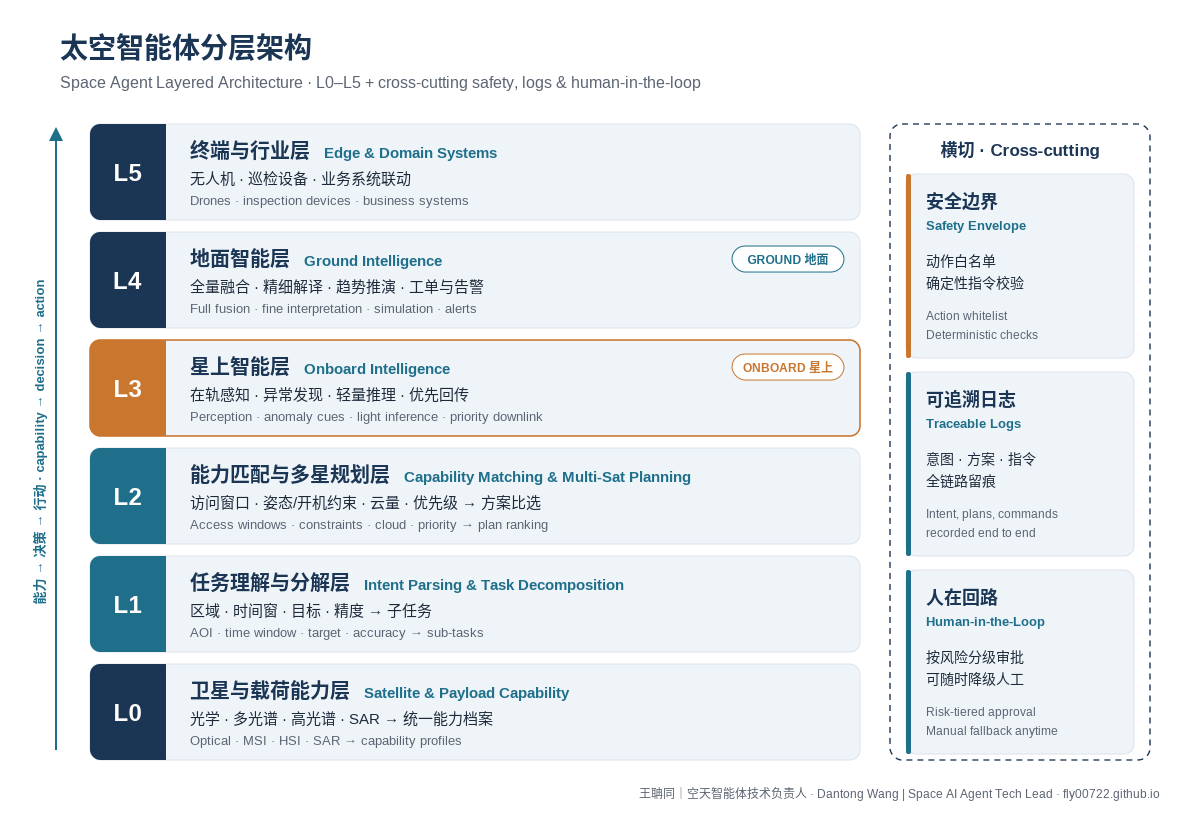
I split a space agent into six layers, bottom to top:
- L0 — Satellite & payload capability layer. Heterogeneous payloads (optical, multispectral, hyperspectral, SAR) are abstracted into capability profiles: resolution, swath, imaging modes, power-on constraints, revisit, and data volume. This is the foundation. The agent never calls "satellite X"; it calls "a capability." The schema of the profile decides whether higher layers can compare options across satellites at all.
- L1 — Intent parsing & task decomposition. The LLM turns "show me how flooding in this basin changed over the last three days" into an area of interest, a time window, target types, accuracy requirements and a delivery format, then splits it into executable sub-tasks. The most common failure here is implicit constraints: conditions the user never stated but the business requires.
- L2 — Capability matching & multi-satellite planning. Using ephemerides and access windows, attitude and power-on constraints, cloud forecasts and task priority, this layer generates and ranks candidate plans. The LLM models the problem and explains the trade-offs; the actual combinatorial optimization stays with a deterministic solver. Letting an LLM write the timeline directly is neither verifiable nor reproducible.
- L3 — Onboard intelligence. In-orbit perception, anomaly detection and lightweight inference that decide which products go down first. Its value is simple: downlink less, downlink sooner, downlink the right thing.
- L4 — Ground intelligence. Full-volume fusion, fine-grained interpretation, trend simulation, and the generation of work orders and alerts. Ground compute is not power-constrained; it is the backstop for accuracy and completeness.
- L5 — Edge & domain systems. Drones, inspection devices and business systems that turn a satellite conclusion into action in the field.
Three cross-cutting concerns run through every layer. None is optional for production:
- Safety envelope. The set of actions the agent may invoke is an explicit whitelist. High-risk actions such as command uplinks, attitude maneuvers and payload switching must pass deterministic validation.
- Traceable logs. Every intent parse, plan comparison and generated command is recorded, so that "why was it scheduled this way?" always has an answer.
- Human-in-the-loop approval. Actions are tiered by risk. High-risk actions require human confirmation, and the system can drop back to manual mode at any time.
4. The Multi-Satellite Closed Loop: Discover → Verify → Downlink → Assess → Re-task
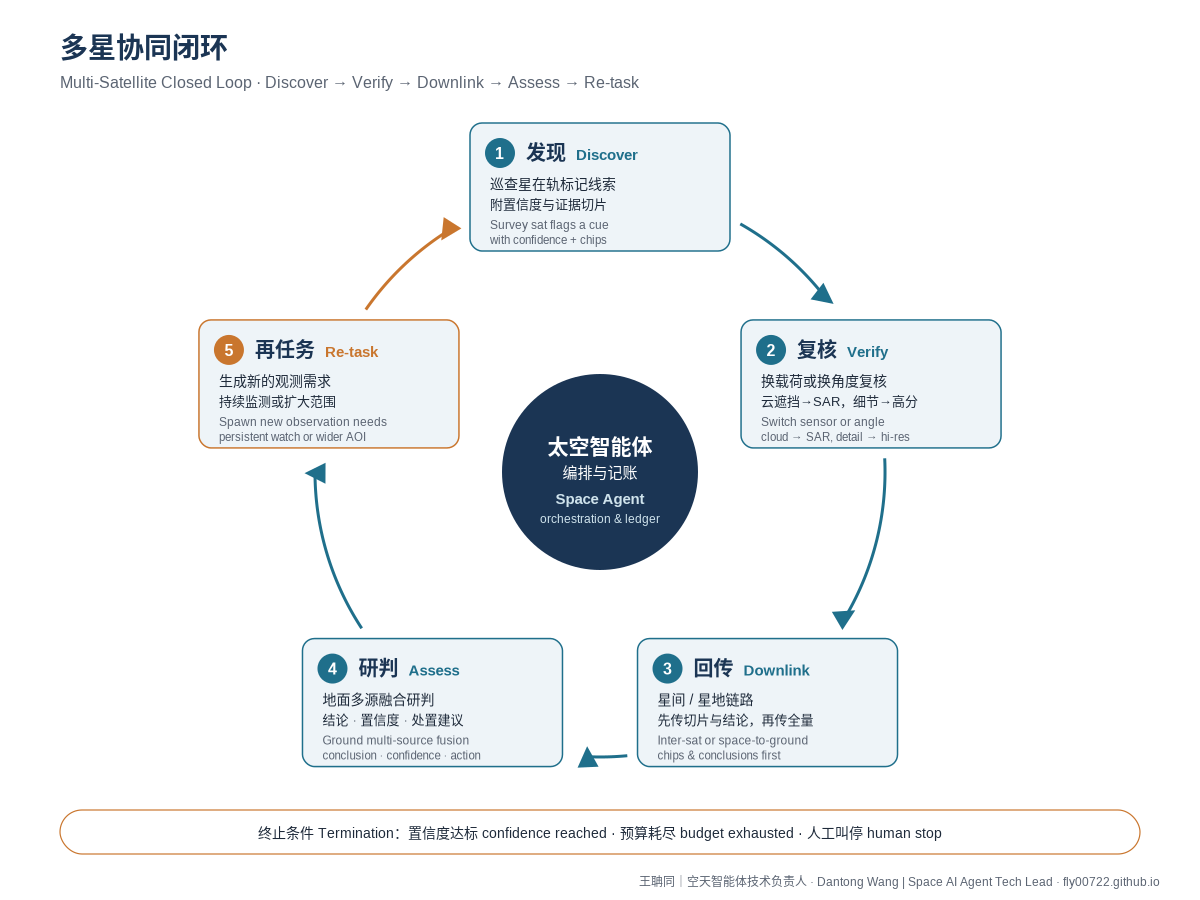
Single-satellite intelligence solves seeing. Multi-satellite collaboration solves confirming and acting. A typical loop has five steps:
- Discover. During a pass, a survey satellite's onboard model flags a candidate (a thermal anomaly, a sudden water-body change, a possible vessel) and emits a cue with a confidence score.
- Verify. The agent picks a verification method based on the cue type: switch to SAR if optical is clouded out, to a higher-resolution sensor if detail is insufficient, to hyperspectral if spectral discrimination is needed. L2 slots the verifying satellite into an access window.
- Downlink. Over inter-satellite or space-to-ground links, chips and conclusions come down first by priority; full-volume data follows when bandwidth allows.
- Assess. Ground intelligence fuses multi-source results into a conclusion, a confidence level and a recommended response.
- Re-task. The assessment generates new observation needs, such as persistent monitoring or a wider area, and the next loop begins.
Two engineering rules keep this loop honest. Every cue must carry a confidence score and evidence chips, or verification has nothing to work with. Every loop must have a termination condition (confidence reached, budget exhausted, or a human stop), or the agent will keep assigning itself work indefinitely.
5. Four Key Design Trade-offs
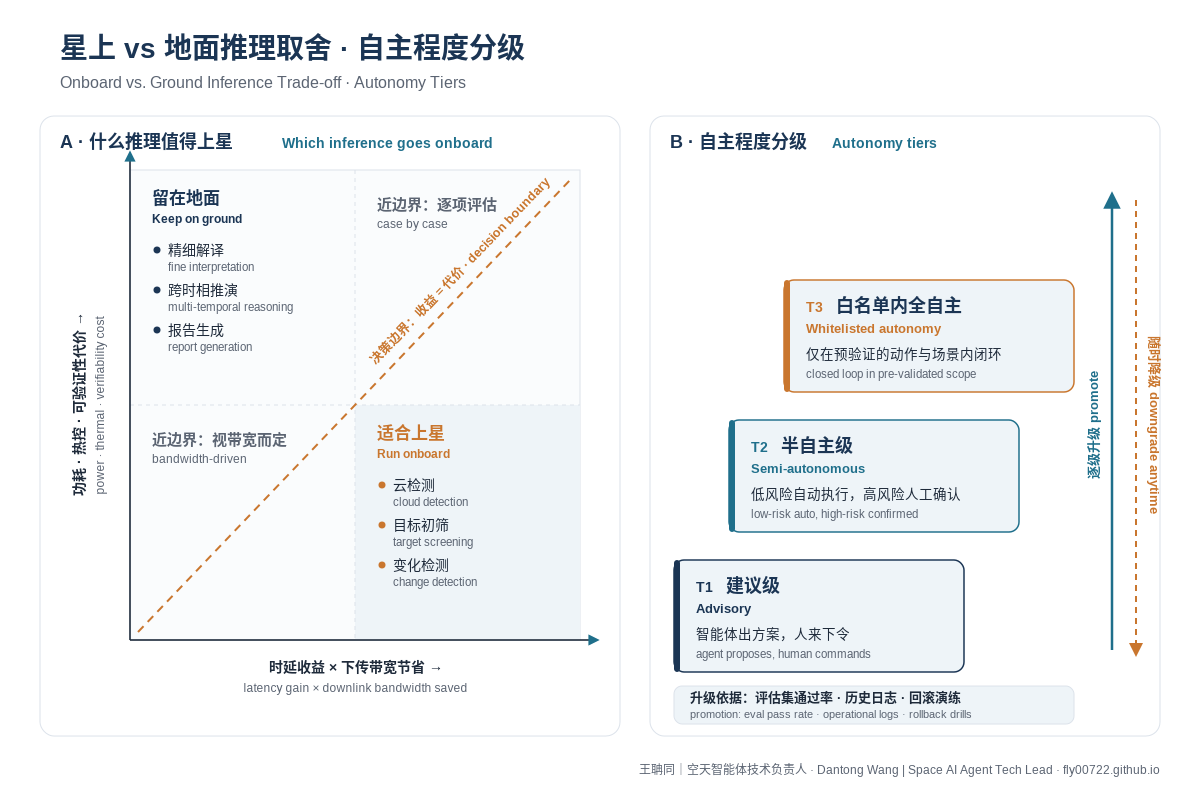
Trade-off 1: Which inference belongs in orbit. The test is an inequality: does latency gain × downlink bandwidth saved outweigh the cost in power, thermal load and verifiability? Filtering tasks such as cloud detection, target screening and change detection belong onboard, because a mistake only means one image too many or too few. Fine-grained interpretation and multi-temporal reasoning stay on the ground, where results can be re-checked and rolled back at will.
Trade-off 2: General multimodal LLMs vs. remote-sensing vertical models. General models generalize well and excel at understanding requests and writing reports. Vertical models are more accurate and cheaper on specific sensors and tasks, and far easier to evaluate. My answer is division of labor, not either/or: general models handle intent parsing in L1 and report generation in L4; vertical models handle perception in L3 and L4.
Trade-off 3: Centralized planning vs. distributed negotiation. Centralized planning finds better global solutions and is easy to audit, but depends on ground links. Distributed negotiation keeps working through link outages, but is hard to verify and prone to oscillation. The pragmatic design is centralized ground planning by default, with onboard re-planning only inside a pre-authorized scope, reconciled with the ground once the link returns.
Trade-off 4: Tiered autonomy. I recommend three tiers: Advisory (the agent proposes, a human commands), Semi-autonomous (low-risk actions execute automatically; high-risk actions need confirmation), and Whitelisted autonomy (closed-loop only within pre-validated actions and scenarios). Promotion between tiers is earned through evaluation-set pass rates, operational logs and rehearsed rollbacks, not through model benchmark scores.
6. Five Engineering Hurdles
- Standardized capability profiles. Satellites from different operators and vendors describe their parameters differently. This is the first wall multi-satellite collaboration hits. Without a common profile, the agent needs a custom adapter for every satellite.
- Evaluation sets and release gates. Every capability the agent can invoke needs a held-out evaluation set and an explicit release threshold. "Intelligence" without a gate is, operationally, just loss of control.
- Simulation first. Orbits, access windows, eclipses, power-on constraints and link availability should all run end to end in simulation before touching a real constellation. Simulation also becomes your regression-test harness.
- Safety envelope and rollback. Action whitelists, command validation, version rollback and degradation plans have to be designed in on day one, not bolted on after an incident.
- Operational observability. Every agent decision must be visible, measurable and reviewable: success rate, mean loop-closure time, human-intervention rate, false-alarm rate. A system you cannot see is a system you cannot improve.
7. Generic Application Scenarios
- Disaster response. Disaster-chain simulation identifies secondary-risk zones; the agent schedules follow-up imaging and verification accordingly, turning "where do we shoot first?" from intuition into an explainable ranking.
- Wildfire risk. Onboard thermal-anomaly screening, verification by a second satellite, ground-side spread simulation, and hand-off to patrol devices.
- Power-line corridor inspection. Periodic surveys plus densified observation of anomalies, with conclusions turned directly into inspection work orders.
- Crop monitoring. Multispectral time series, with automatic densification during key phenological stages.
- Ocean and water resources. Water-body change, shoreline and maritime target monitoring, switching to SAR automatically when optical is clouded out.
What these share: recurring demand, time sensitivity, and the need for multi-source cross-confirmation. That is exactly where a space agent beats a manual chain by the widest margin.
8. A Three-Year Outlook, and What Is Still Unsolved
My view of the next three years:
- From single-satellite intelligence to constellation intelligence. Competition will shift from per-satellite compute to multi-satellite orchestration and the coverage of capability profiles.
- From tool calling to multi-agent negotiation. Onboard, ground and edge will each run specialized agents that negotiate tasks through constrained protocols.
- From ground as backstop to shared space–ground governance. Satellites will gain more pre-authorized local decision rights; the ground keeps audit, arbitration and rollback authority.
Problems that remain open, stated plainly:
- Verifiability. Once an LLM participates in planning, how do we formally prove a plan never violates hard constraints?
- In-orbit model updates. Uplink bandwidth is limited and validation windows are short. How do models iterate safely in orbit?
- Accountability. When an autonomous decision inside the whitelist goes wrong, how is the chain of responsibility defined?
- Cross-operator collaboration. Can satellites from different operators share capability profiles and task protocols? That needs industry-level standards.
9. FAQ
Q1: Is a space agent just an LLM running on a satellite? No. The LLM is the planning and reasoning core, and it mostly runs on the ground. Onboard, you mostly run lightweight vertical models. A space agent is the whole task protocol and decision loop across L0–L5.
Q2: What if onboard compute is not enough? Layer the work. Run only filtering, latency-sensitive inference in orbit, such as screening and priority downlink, and keep heavy computation on the ground. The test: does latency gain × bandwidth saved outweigh the cost in power, thermal load and verifiability?
Q3: How is safety guaranteed? Through three cross-cutting concerns: an action whitelist with deterministic validation, end-to-end traceable logs, and risk-tiered human-in-the-loop approval. Autonomy is granted in tiers and can always be downgraded to manual.
Q4: How does it relate to classical mission planning systems? It complements them rather than replacing them. The classical planner is the solver the agent calls in L2 to produce feasible plans under hard constraints. The space agent handles intent, plan comparison, loop closure and re-tasking.
Q5: How can an individual or small team get started? Start in simulation. Use Skyfield3 or Orekit4 for orbit propagation and access windows, public orbital elements from CelesTrak5, and GMAT6 or Basilisk7 for mission and attitude simulation. Define a minimal capability profile and one "discover → verify" loop first, then add an LLM for intent parsing.
10. About the Author
Personal technical views only; not the position of any organization. The architecture described here is a generic framework and does not reflect the parameters of any real constellation. Originally published at https://fly00722.github.io/articles/what-is-a-space-agent/en.html
References
-
ESA, "Φsat", https://www.esa.int/missions/about-us/directorates/earth-observation-programmes/futureeo/fsat/phsat ; paper: G. Giuffrida et al., "The Φ-Sat-1 Mission: The First On-Board Deep Neural Network Demonstrator for Satellite Earth Observation", IEEE TGRS, 2021, https://doi.org/10.1109/tgrs.2021.3125567 ↩
-
Xinhua, "具备太空在轨计算能力 我国太空计算卫星星座发射看点解析" (launch of China's space computing constellation), 14 May 2025, https://www.news.cn/20250514/2d5722b14cd142c4b6bcaeb4fcead847/c.html ↩
-
Skyfield, https://rhodesmill.org/skyfield/ ↩
-
Orekit, https://www.orekit.org/ ↩
-
CelesTrak, https://celestrak.org/ ↩
-
NASA General Mission Analysis Tool (GMAT), https://sourceforge.net/projects/gmat/ ↩
-
Basilisk Astrodynamics Simulation Framework, https://github.com/AVSLab/basilisk ↩